- December
- Our Oracle project proposal to continue our collaboration on garbage collection was funded. This project will start in Spring of 2021 and run for at least one year.
- November
- My project proposal to the Swedish research council on acceleration of managed languages was funded. This project will start in January 2021 and run for four years.
- October
- I am the general chair of ISMM 2021, co-located with PLDI 2021. If you are doing any work in the area of memory management, you should definitely consider submitting to ISMM.
- August
- I am serving on the programme committee of PLDI 2021. The deadline for submissions is Friday, November 20, 2020. If you are doing great work in programming languages, you should definitely consider submitting to PLDI.
- August
- Keynote: Martin Henz and myself are featured on ICFP's Scheme workshop programme, talking about the SICP JS project: SICP JS: Ketchup on Caviar?, tune in!
- June
- Jonas Norlinder's master thesis, Moving Garbage Collection with Low-Variation Memory Overhead and Deterministic Concurrent Relocation, has been approved. Notably, Jonas won 3rd prize in the PLDI Student Research Competition for his poster based on that work.
- June
- Michael Rehn's master thesis, Garbage Collected CRDTs on the Web: Studying the Memory Efficiency of CRDTs in a Web Context, has been approved.
- June
- PhD position open in a project on execution environments for high-level programming languages. Deadline to apply 2020-06-25. Part of this work will be done in collaboration with Oracle.
- June
- Our artefact for Reshape your layouts, not your programs: A safe language extension for better cache locality has been accepted to ECOOP 2020. Great work Alex Tasos!
- May
- The artefact for our paper Improving Program Locality in the GC using Hotness with won the distinguished artefact award at PLDI 2020. Our artefact downloaded and built OpenJDK, then applied a patch for the work in our paper, and then built a modified OpenJDK version. With these two versions, a reviewer could then recreate all plots from our paper on their own hardware. Kudos to artefact reviewers who ran the full set of benchmarks (which takes more than one week!).
- April
- Albert Yang's paper ThinGC: Complete Isolation With Marginal Overhead has been accepted to ISMM 2020. This is a collaboration with Oracle (Erik Österlund and Jesper Wilhelmsson) and includes work done by a master student from KTH (Hanna Nyblom).
- April
- Our paper Reshape your layouts, not your programs: A safe language extension for better cache locality has been accepted to Science of Computer Programming. This is the culmination of lots of work by Alex Tasos and Juliana Franco, Sophia Drossopoulou, Susan Eisenbach, and myself. And the best is yet to come as we will now allow ourselves to move forward!
- April
- The artefact for Albert Yang's paper Improving Program Locality in the GC using Hotness with Erik Österlund from Oracle and myself has been accepted to PLDI 2020 with a reusable badge.
- April
- I have been promoted to full professor of computing science (datalogi in Swedish) at Uppsala University.
- March
- My master student Jonas' entry to the PLDI 2020 Student Research Competition has been accepted. Jonas' topic is reducing the memory footprint of OpenJDK under ZGC and making it more predictable, by reengineering the forwarding tables and changing semantics of relocation so that object placement is deterministic, even with mutators and GC threads racing to relocate objects.
- February
- My PhD student Albert's paper Improving Program Locality in the GC using Hotness with Erik Österlund from Oracle and myself has been accepted to PLDI 2020.
- January
- Starting from January 1st, I am serving as the Head of Education at the department. We are currently making big changes to how we manage education, so this is doubly exciting an a great time to take on this role.
- September
- Our paper Run Actor, Run on benchmarking actor applications has been accepted to the AGERE 2019 workshop. This is joint work between Sebastian Blessing, Albert Mingkun Yang, Kiko Fernandez-Reyes, Sophia Drossopoulou and myself. The paper argues the need for stating clear rules for cross-language benchmarking games, as well as takes the first steps towards defining a multi-faceted actor benchmark.
- August
- My PhD student Malin's paper to Managed Programming Languages and Runtimes on Performance of an OO Compute Kernel on the JVM — Revisiting Java as a Language for Scientific Computing Applications has been accepted. In this paper we evaluate the performance of C++ and JVM compute kernels, and investigate the state of Java for Scientific Computing in 2019.
- July
- The artefact for our paper Godot — all the benefits of explicit and implicit futures won the distinguished artefact award at ECOOP.
- July
- the end of the year, I am on a sabbatical visiting the Department of Computer Science at the National University of Singapore. Thus, I am in Time Zone UTC+8, and cannot regularly be reached through my Swedish cell phone number.
- June
- I am serving on the Programme Committee for SPLASH-E (the SPLASH Education Track) in 2019. The deadline is July 12, but this year SPLASH-E has a flexible deadline option.
- May
- I am proud to report that I am the 2019 recipient of the pedagogical award in the Math, Science, and Technology faculty. > **Motivation** > > Tobias Wrigstad is passionate about his teaching. With pedagogical ability and subject knowledge, he inspires his students. He continuously develops his pedagogy with the goal that students should take their own responsibility for their learning. With innovative teaching and examination forms, enthusiasm and responsiveness, Tobias promotes student learning and interest in the subject. Tobias also generously shares his educational experiences with colleagues.
- May
- Evaluated Artefact accepted — companion to the Godot paper which is to appear at ECOOP, by Kiko Fernandez-Reyes, Dave Clarke, Einar Broch Johnson, Ludovic Henrio and myself.</br> The artefact contains a prototype implementation of the formalisms in the paper in Scala, to serve the community members who rather look at executable code than operational semantics when implementing features.
- May
- Paper accepted to <PROGRAMMING> 2020: Reference Capabilities for Safe Parallel Array Programming, by Beatrice Åkerblom, Elias Castegren and myself.
 
The paper extends our previous work on reference capabilities with support for arrays. Array capabilities are abstract array views that offer a consequtive view of (the possibly "scattered" elements of) the underlying array. Array manipulation of unique reference capabilities preserves uniqueness, and there are many nice borrowing patterns that showcase the usefulness of borrowing to temporarily decompose a structure and using borrowing to snap it back together again.
 
One of my favourite lines of the paper is the showcasing of how a matrix encoded as an array can be rotated with a single line of code: align(merge(split(matrix, Cols, True), True)) (see the forthcoming paper for details).
- May
- Paper accepted to the IFAC Symposium on Advances in Control Education (ACE 2019): Quantitative Analysis of Curricula Coherence Using Directed Graphs, by Steffi Knorn, Damiano Varagnolo, Kjell Staffas, myself, and Eva Fjällström.</br>
- May
- CurryOn talk: Run, Actor, Run!</a>, by Sebastian Blessing, Sophia Drossopoulou and myself.
Together with Sophia and Sebastian (and since then a growing team including Kiko Fernandez-Reyes and Albert Mingkun Yang), we are looking at the performace of actor languages on big machines. Stay tuned!
- April
- I will be serving on the Programme Committee for Onward! in 2019.
- April
- ECOOP paper accepted: Godot: All the Benefits of Implicit and Explicit Futures by Kiko Fernandez-Reyes, Dave Clarke, Einar Broch Johnson, Ludovic Henrio and myself.
This work explore two kinds of futures — data flow futures and control flow futures and their use in a single, explicitly typed system.
- April
- I am serving on the PhD committe of Nathalie Oostvoegels, adviced by Wolfgang De Meuter at VUB.
- April
- Visiting Martin Henz at the National University of Singapore (NUS).
- April
- I have been awarded a STINT scholarship to do a teaching sabbatical at National University of Singapore (NUS) in the fall of 2019. My host is Martin Henz.
- january
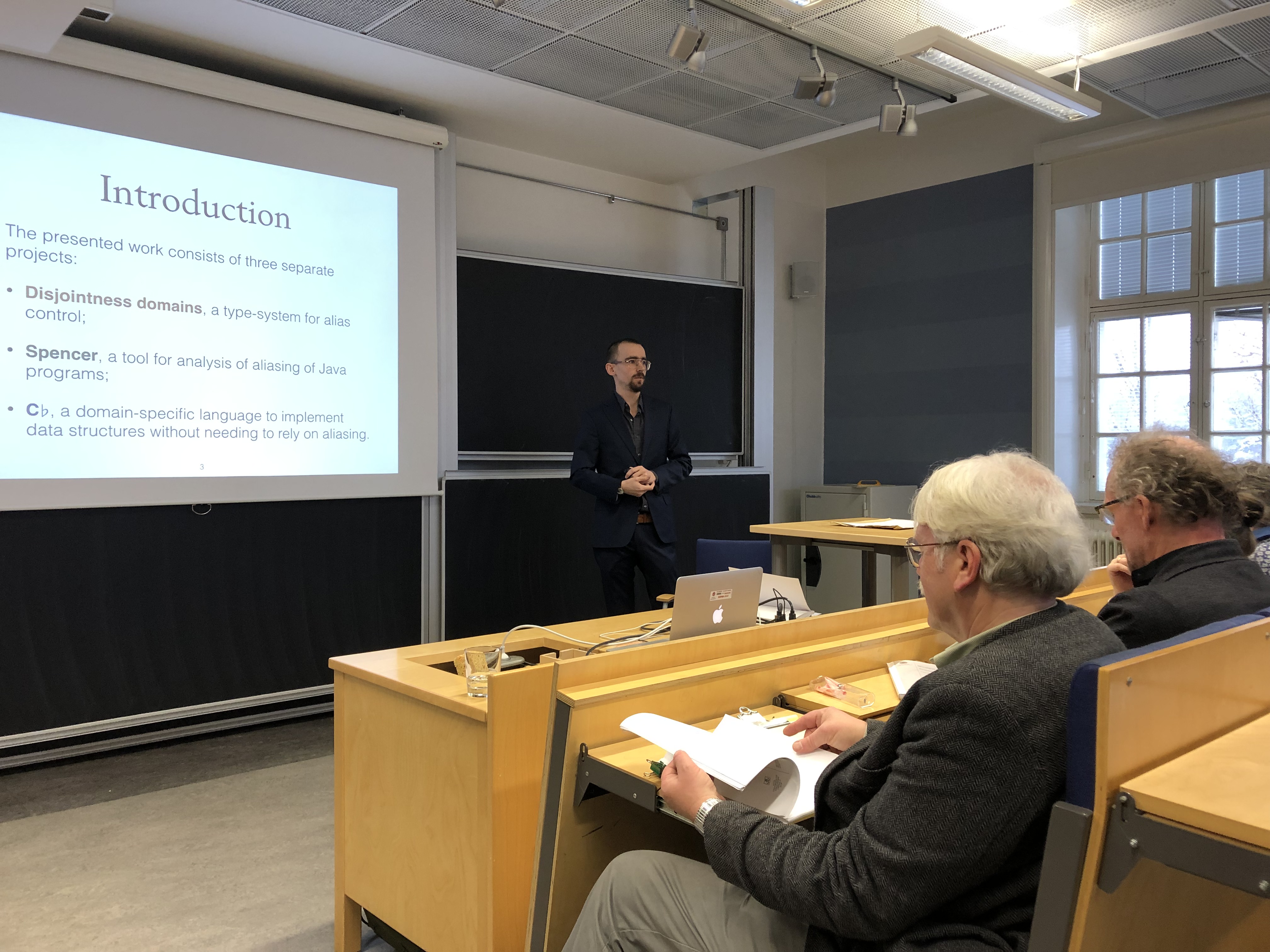
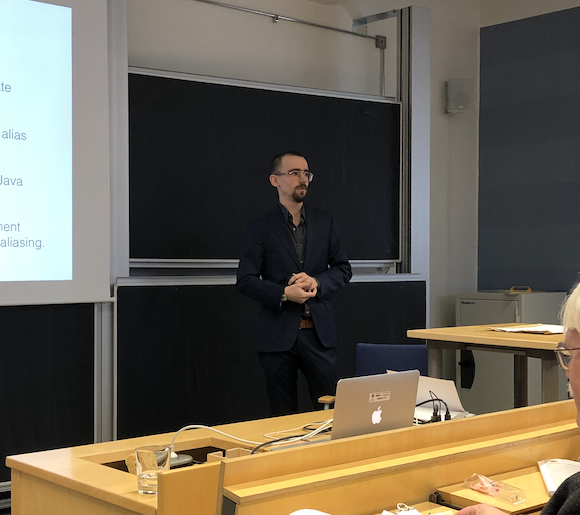
- Stephan Branduaer, PhD just graduated. The opponent was Professor Doug Lea from SUNY Oswego, and the grading committe consisted of Professor Magne Haveraaen from University of Bergen, Professor Görel Hedin, LTH, and Associate Senior Lecturer Elisabeth Larsson, Uppsala.
- January
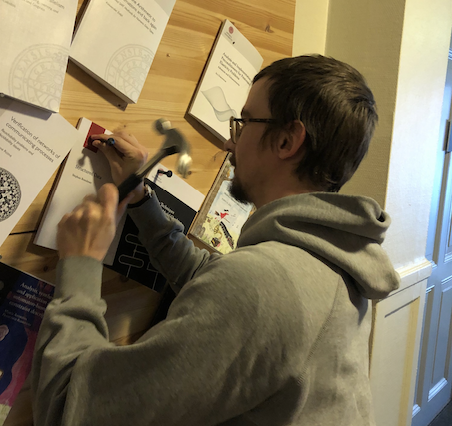
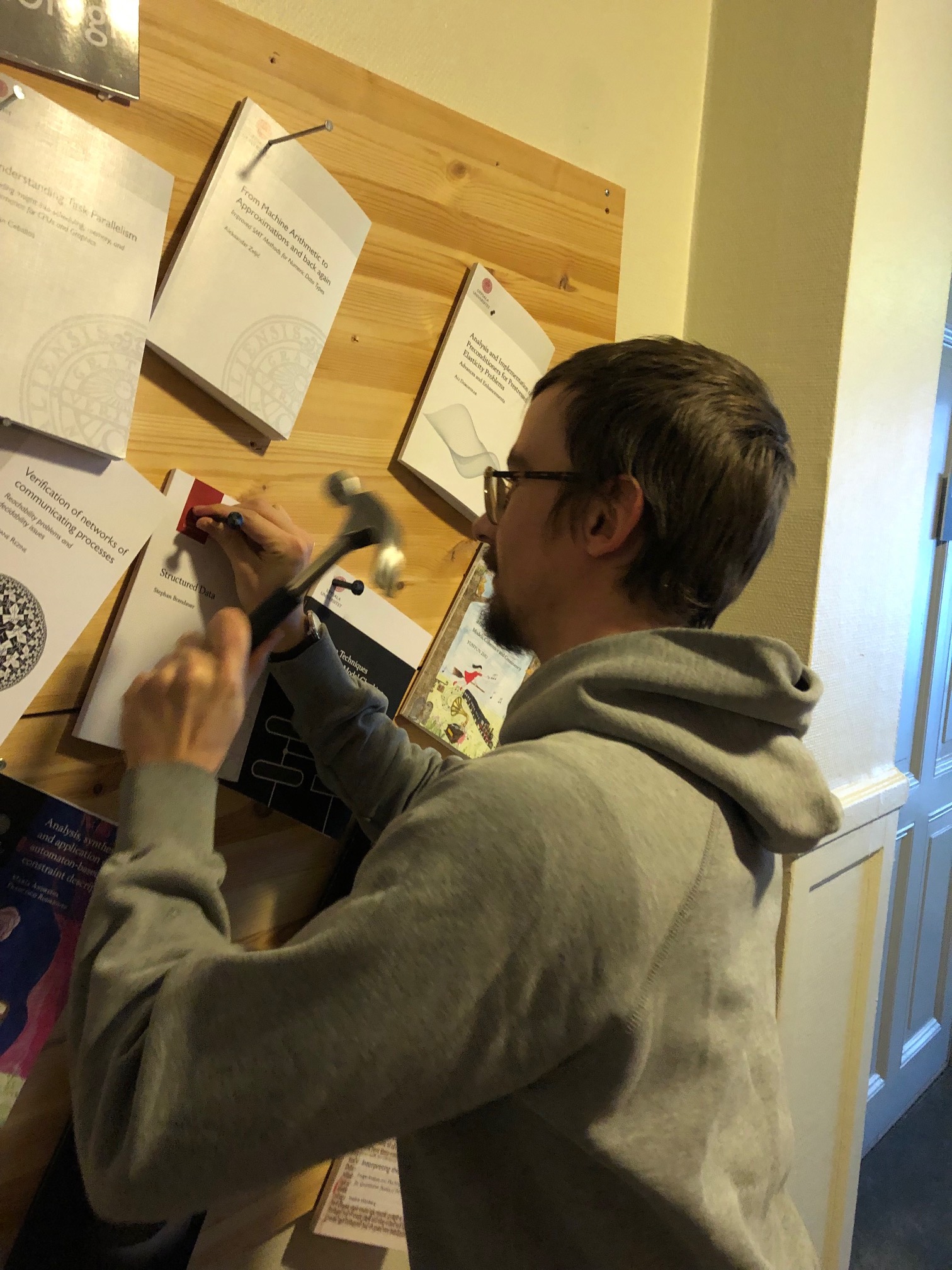
- My PhD student Stephan Brandauer just nailed his thesis, as part of the ritual of announcing his public PhD defence on January 23rd. The grading committee consists of Professor Magne Haveraaen, Professor Görel Hedin, Associate Professor Elisabeth Larsson and Professor Björn Victor. The opponent is Professor Doug Lea, SUNY Oswego, US.